
When Compassion Fatigue Shapes Our Reactions
When Compassion Fatigue Shapes Our Reactions
In recent days, I’ve noticed therapists responding in very different ways to a public tragedy. Some expressed sorrow. Others anger. Some expressed confusion.
I’ve been avoiding social media lately to protect my focus and energy, but...
I’m seriously in about 100 or so therapist Facebook groups, and the noise can be overwhelming on Facebook in general and sometimes in these spaces. I often hang back but this time, I felt called to speak.
It often takes me a while to sit, reflect, and zoom out before I respond. I’m neurodivergent, and I used to be more impulsive. These days, I practice boundaries (something I shared in a recent live) and give my thoughts space to form before I speak.
A Wide Range of Reactions
I’m seeing a wide range of responses from therapists — and then reactions to those reactions.
There’s shock, anger, numbness, and everything in between. Some conversations have even escalated into arguments. At times, certain therapist spaces feel less safe than usual.
In some groups, I’ve even seen therapists reporting one another for what they post — or warning that “you could lose your license” over certain comments. That kind of threat only heightens the tension.
Part of the difficulty is that we aren’t supposed to counsel each other in these spaces. We’re expected to remain professional and a little distanced. But that leaves us in a spiral: not sure how to respond, not sure how to support each other, and not sure what “professional” should look like in moments like this.
What’s Beneath the Reactions?
When I sat with these conversations longer, I began to wonder: what if these sharp, polarized reactions aren’t simply about empathy or lack of it? What if they’re signs of compassion fatigue — trauma responses showing up in our profession?
In my dissertation research, I found three main themes in how therapists described their experiences of compassion fatigue:
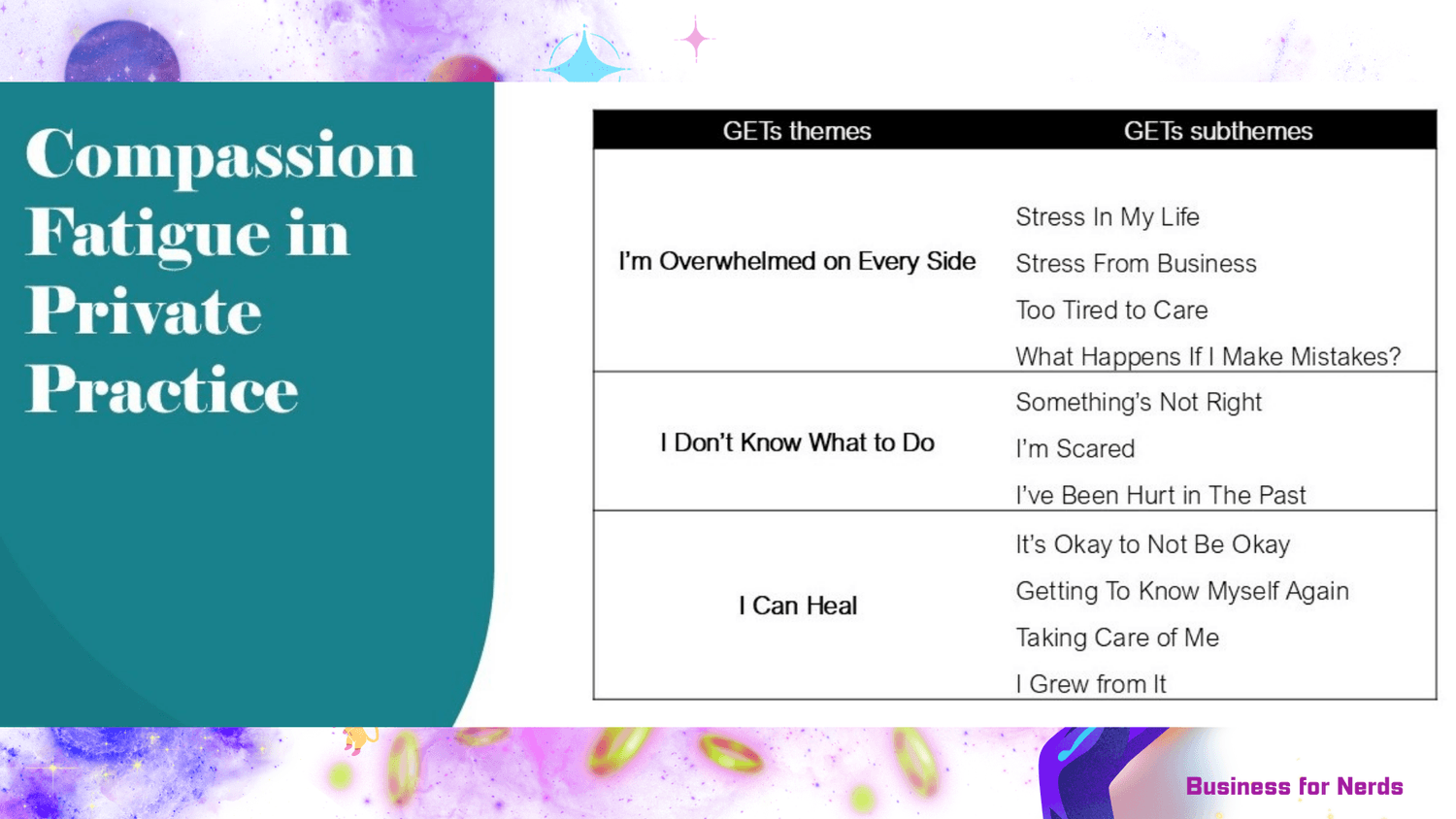
I'm Overwhelmed On Every Side
As therapists, we’ve held so much in recent years:
The COVID-19 pandemic and its aftermath
Environmental disasters in multiple states
Escalating political conflict and polarization
Violence, hate crimes, and mass shootings
Grief and loss at both societal and personal levels
We’ve been sitting in the front row of all of it. We’ve held space for clients experiencing these events while living through them ourselves.
That double exposure is heavy. And when our own nervous systems are maxed out, fatigue, irritability, or even anger can show up. These are human trauma responses — not necessarily failures of empathy.
I Don’t Know What to Do
And then there’s the uncertainty. In my research, therapists described this as:
“Something’s not right”
“I’m scared”
“I’ve been hurt in the past”
In today’s therapist spaces, it can show up as second-guessing ourselves, worrying about how peers perceive us, or even fearing professional consequences for how we respond. That layer of fear only adds to the exhaustion.
I Can Heal: What Helps in Practice
These aren’t cures; they’re reset practices that protect your capacity to care.
🌱 3 Core Resets
1) Self-Compassion (start here)
Name what’s true: “This is heavy, and I’m human.”
Normalize fatigue; it’s an occupational hazard, not a personal failure.
Micro-practice: put a hand on heart, 3 slow breaths, silently: “This is hard. I’m allowed to care for me, too.”
2) Boundaried Self-Care (not spa day—nervous-system care)
Basic care: sleep, water, movement, food you can actually digest.
Stop-doing: reduce inputs that spike you (doomscrolling, debate threads).
Tiny restorers: 10-minute walk, sunlight, stretch, quiet cup of something warm.
3) Peer Support (the antidote to isolation)
One trusted colleague > ten noisy groups. (looking at the FB groups I'm in)
What to ask: “Can we trade a 20-minute debrief? No fixing—just witness + one next step.”
Consider a standing consult buddy during charged news cycles.
🛠️ Additional Supports
Supervision / Consultation / Therapy
Use consultation to name risk and lower shame.
Therapy for the counselor: sort countertransference, grief, and identity fatigue.
If prior supervision harmed trust: choose competence + safety over convenience.
Meaning-Focused Coping
Ask: “What meaning can I make that helps me act with care?”
Reframe from “I must hold it all” → “I can hold my part and choose one humane action.”
Spirituality or Values Practices (if relevant to you)
Prayer, meditation, nature, ritual—anything that reconnects you to why you help.
Boundaries That Protect
Time: lighter caseload weeks after community crises.
Content: avoid debating in public threads; redirect to safer containers.
Access: protect lunch, end-of-day buffer, and actual days off.
A Tiny Reset You Can Do Today
5 minutes: breathe + hand on heart; name one feeling; send one text to a trusted peer.
15 minutes: short walk; no phone; choose one boundary you’ll keep this week.
60 minutes: schedule a consult or therapy session; map one adjustment to your caseload or hours.
Want to dig deeper?
Here are some reflection questions:
👉 “What’s one part of me that’s been on autopilot for too long?”
👉 “Where might my energy actually want to go?”

👆Click the Robot, she has something to tell you!

Hey! I'm Dr. Willey
Hi, I’m Dr. Brie-Anna Willey—a therapist, coach, creative, and business nerd passionate about helping therapists, helpers, coaches, creatives, and fellow business nerds build businesses they love. With a doctorate in Community Care and Counseling from Liberty University and a wealth of experience as a licensed mental health counselor and certified professional coach, I specialize in guiding private practice owners through the unique stressors they face while helping them diversify their income streams.



JOIN MY MAILING LIST

Business for Nerds-Case Studies.
Coaching and educational content only; not mental health treatment.
Quick links
Newsletter
Subscribe now to get daily updates.